2025 Water Quality Report
Our Water Quality Report is released annually in May.
Click here to download a PDF. To request a copy by mail, please email Info@FayPWC.com.
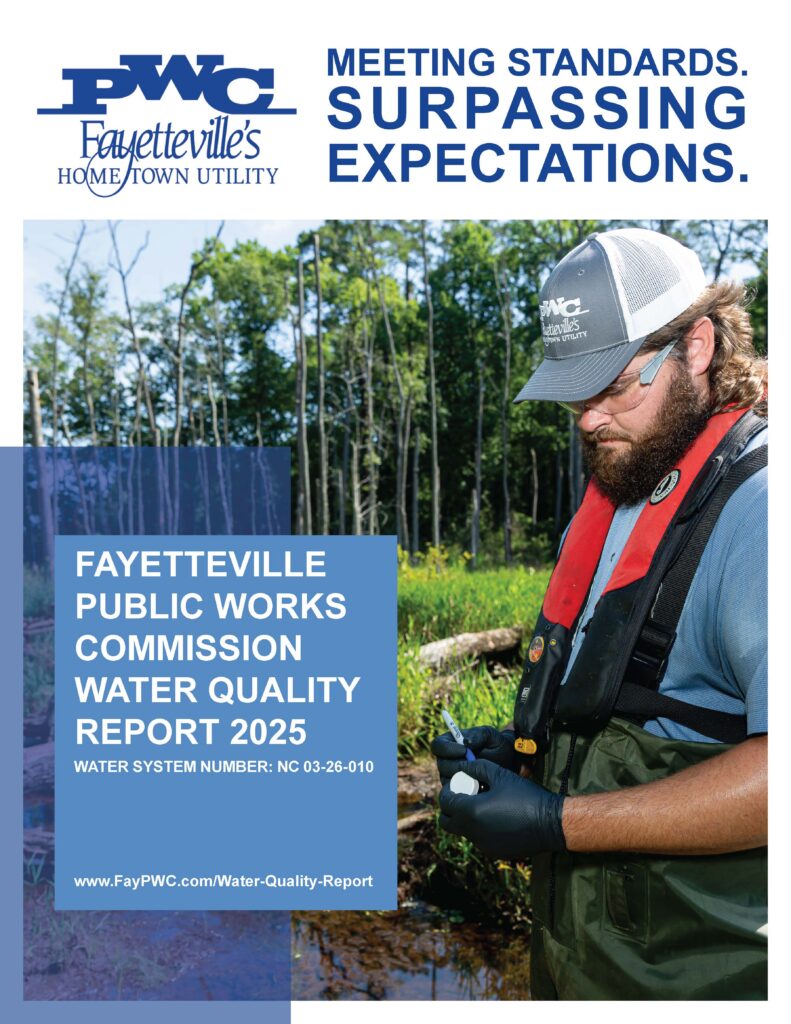
Meeting Standards. Surpassing Expectations.
Fayetteville Public Works Commission 2025 Water Quality Report
PWC cares deeply about the quality of the water provided to its customers and is proud of the exceptional standards maintained by PWC staff. Each year, a “Water Quality Report” is published with the results of testing PWC is required to perform. You can find full details of this report below.
PWC’s commitment to water testing is about more than meeting regulatory requirements, it is the right thing to do. It reflects an unparalleled commitment to provide you with the highest quality drinking water that meets and surpasses regulatory requirements.
Above and Beyond
PWC is proud to be a charter member of the national Partnership for Safe Water. PWC was the first utility in North Carolina to earn the Environmental Protection Agency (EPA) Director’s Award for water treatment, recognizing PWC’s extra efforts in providing clean and safe drinking water that exceeds federal drinking water standards. PWC has received this prestigious recognition for 25 consecutive years.

In 2011, PWC became a charter member of the Partnership for Safe Water Distribution System Optimization Program. This program focuses on the operation and maintenance of water treatment facilities, water mains, and storage tanks. In 2014, PWC completed the 18-month self-assessment phase of the program and was among the first utilities in the country to be recognized for this achievement.
PWC was recognized with the 2024 Gold Award for Exceptional Utility Performance by the Association of Metropolitan Water Agencies (AMWA). This distinguished honor is only awarded to a small number of utilities every year, and a utility can only receive it once. PWC received this award due to its continuing commitment to cutting-edge water treatment technology and dedication to providing safe and reliable drinking water.
In 2025, NC One Water recognized PWC with two of its highest distinctions: Water Distribution System of the Year – Overall Winner Award and Wastewater Collections System of the Year – Large System Award. These awards highlight PWC’s commitment to delivering safe, reliable, and affordable water and wastewater services to the greater Fayetteville community.
10.5 Billion Gallons. 150,000 Tests.
To make sure your drinking water is clean and safe, PWC’s two Water Treatment Facilities – P.O. Hoffer and Glenville Lake – use advanced technology and proven methods to process the water provided to customers. In 2025, more than 10.5 billion gallons of water were treated. To ensure strict compliance with EPA regulations and the safety of the water provided, water quality is continuously monitored through more than 150,000 tests per year.
Where Your Water Comes From
All of the water treated by PWC is “surface water.” The water processed at PWC’s P.O. Hoffer Water Treatment Facility comes from the Cape Fear River. Water processed at PWC’s Glenville Lake Facility comes from the Cape Fear River, Big Cross Creek, and the Little Cross Creek Watershed, which contains four bodies of water used for water storage: Bonnie Doone Lake, Kornbow Lake, Mintz Pond, and Glenville Lake. Both of PWC’s treatment facilities provide water to the general distribution system, so the water you drink is a blend of water processed from these sources.
How Is Your Water Treated?
While the treatment process varies slightly at PWC’s two water treatment facilities, the basic steps are similar.
The Disinfection Method
PWC uses chloramination as the main disinfectant. Chloramine inactivates and prevents pathogen growth within the system by utilizing both ammonia and chlorine. Ammonia is added to the water at a carefully controlled level, and the chlorine and ammonia react chemically to produce chloramines. This method inactivates the COVID-19 virus, as well as other coronaviruses.
Chloraminated water is perfectly safe for drinking, cooking, bathing, and other daily water uses. There are, however, two groups of people who need to take special care with chloraminated water: customers who use drinking water for kidney dialysis machines and fish owners. For more information on chloramination, including special precautions these special groups should take, contact PWC. As an extra measure of safety, the North Carolina Department of Environmental Quality (NCDEQ) requires all water systems using chloramination to suspend the addition of ammonia for a one-month period each year. PWC does this each March to prevent any biological growth and nitrification from occurring in the water distribution system.
The Treatment Process
PWC operations and maintenance staff are committed to providing safe, high-quality drinking water for its customers. When raw surface water enters the facility, ferric sulfate is added, causing small particles to adhere to one another. This makes the particles heavy enough to settle out of the water in a sedimentation basin. The water is then filtered through sand and anthracite to remove any remaining fine particles. Ammonia and chlorine are added to kill harmful bacteria, protozoans, and viruses. Lime or caustic soda and a corrosion inhibitor are added to minimize the potential for dissolving the lead solder used on copper piping in older household plumbing. Fluoride is added as an aid in preventing tooth decay. Both facilities also add powdered activated carbon to reduce substances that produce unpleasant tastes and odors. Treated water proceeds through a series of pumps and storage facilities before being delivered to your home.
An Extra Measure of Concern
As noted above, PWC adds fluoride to your water supply. Proven as a safe and healthy way to effectively prevent tooth decay, community water fluoridation has been recognized by the U.S. Centers for Disease Control (CDC) as one of the ten great public health achievements of the 20th century.
PWC’s Water Meets or Surpasses All EPA Standards
PWC annually tests for 118 elements and contaminants regulated by the EPA and meets or surpasses all standard requirements annually. Your drinking water, including bottled water, may reasonably be expected to contain small amounts of some contaminants. However, the presence of contaminants does not necessarily indicate that water poses a health risk.
PWC understands that reports of contaminants in local water sources cause concerns about the safety of its drinking water. Staff share that concern about PFAS, as providing safe, high-quality drinking water that meets or exceeds all current regulatory standards remains the organization’s top priority.
The reports of GenX being discharged into the Cape Fear River are below the PWC/Fayetteville water service area and more than 20 miles downstream of where PWC takes water from the river for treatment. However, instances of GenX and other per- and polyfluoroalkyl substances (PFAS) have been found in PWC’s sampling.
It has been well reported that the predominant source of emerging compounds is the use and manufacturing of products including cosmetics, shampoos, paints, food packaging, cleaning, and stain- and stick-resistant products.
Prior to the EPA announcing proposed PFAS drinking water standards in 2023, there had been no established regulatory limits for PFAS in drinking water. However, for nearly 10 years, PWC has advocated with regulatory agencies to reduce and prevent the discharge of industrial pollution/PFAS into the Cape Fear River, PWC’s primary drinking water source. While PFAS are present in PWC’s source water, the EPA says 70% of a consumer’s exposure to emerging compounds comes from non-drinking water sources.
PWC understands the public’s desire for swift action to remove PFAS and there is a planned water treatment upgrade to Granular Activated Carbon (GAC) which has been studied at PWC’s plants and determined to be the most effective method for PWC. It is important to know that any water treatment upgrade is a major infrastructure investment and upgrades must be made for each of PWC’s drinking water plants.
As this upgrade is being designed and built to help meet new EPA Drinking Water standards, PWC has been actively working to upgrade its current Powder Activated Carbon (PAC) treatment capabilities to allow a higher dosage than is currently possible. While PAC is not as efficient or economical as GAC, it can effectively remove modest amounts of PFAS and it will assist in addressing PFAS until GAC, which is the best solution, can be installed.
PAC construction began in 2025 and was completed in April 2026. PWC’s GAC upgrade is expected to be operational by Sumer/Fall 2029.
PWC’s top priority is and will continue to be providing safe, high-quality drinking water. PWC is committed to continued advocacy to prevent PFAS from being discharged into PWC’s source water, and in turn, eliminate the exposure and financial burden for its customers.
Some people may be more vulnerable to contaminants in drinking water than the general population. Immunocompromised persons such as those with cancer undergoing chemotherapy, organ transplant recipients, people with HIV/AIDS or other immune system disorders, some elderly, and infants can be particularly vulnerable to infections. These people should seek advice about drinking water from their health care providers.
More information on PFAS, including monthly PWC testing results, can be found on PWC’s website: www.FayPWC.com/PFAS-Facts/
More information about contaminants and potential health effects can be obtained by calling the EPA’s Safe Drinking Water Hotline (800-426-4791).
Operation Clean & Clear-Protecting You From Lead Exposure
PWC is committed to delivering safe water to PWC’s customers. The water PWC provides to homes and businesses is lead-free. While PWC’s water is lead-free, that doesn’t mean there are no lead lines or plumbing in the system.
Copper piping with lead solder, as well as lead service lines, are more likely to be found in homes built before 1986. Among homes without lead service lines, brass or chrome-plated brass faucets may also contribute to lead exposure.
Since 1991, PWC has participated in the Lead and Copper Rule sampling program as required by the Safe Drinking Water Act (SDWA). As a result, PWC implemented a corrosion control program to prevent lead from pipes and fixtures from entering the water system. This corrosion control program has been successful, as all PWC’s samples are well below the EPA-mandated thresholds for lead in drinking water, including PWC’s most recent testing in 2023.
In 2022, PWC began Operation Clean and Clear, a project that helps us continue protecting PWC’s customers from lead exposure by identifying the material used in all water service lines – those maintained by PWC and customers’ service lines connected to PWC’s water mains.
If present in drinking water, elevated levels of lead can cause serious health problems, especially for pregnant women and young children. Lead in drinking water primarily comes from materials and components associated with service lines and home plumbing.
To date since PWC began Operation Clean and Clear, staff have identified line materials for more than 95,800 water services and no lead service lines have been found. Based on records and knowledge of its system, PWC anticipates there to be no or minimal instances of lead service lines but will be documenting all locations.
To learn more about Operation Clean and Clear and to view PWC’s online service line inventory, visit www.FayPWC.com/Operation-Clean-Clear/
If you are concerned about lead in your water, information about lead in drinking water, testing methods, and steps you can take to minimize exposure is available from the Safe Drinking Water Hotline (800-426-4791) or at EPA.gov/Safewater/Lead.
For PWC’s full annual water quality report, visit www.FayPWC.com/Water-Quality-Report
2025 Annual Drinking Water Quality Report
Fayetteville Public Works Commission
Water System Number: NC 03-26-010
Este informe contiene información muy importante sobre su agua potable. Tradúzcalo o hable con alguien que lo entienda bien.
PWC is pleased to present to you this year’s Annual Drinking Water Quality Report. This report is a snapshot of last year’s water quality. Included are details about your source(s) of water, what it contains, and how it compares to standards set by regulatory agencies. PWC’s constant goal is to provide you with a safe and dependable supply of drinking water. PWC wants you to understand the efforts PWC makes to continually improve the water treatment process and protect PWC’s water resources. PWC is committed to ensuring the quality of your water and to providing you with this information because informed customers are PWC’s best allies. If you have any questions about this report or about your water, please contact Jason Green at (910) 223-4710. PWC wants all customers to be informed about their water utility. If you want to learn more, please attend any of PWC’s regularly scheduled meetings. Information on PWC’s meetings, along with links to Webex, can be found at www.FayPWC.com/Commission-Meetings/.
What EPA Wants You to Know
Drinking water, including bottled water, may reasonably be expected to contain at least small amounts of some contaminants. The presence of contaminants does not necessarily indicate that water poses a health risk. More information about contaminants and potential health effects can be obtained by calling the Environmental Protection Agency’s Safe Drinking Water Hotline (800-426-4791).
Some people may be more vulnerable to contaminants in drinking water than the general population. Immunocompromised persons such as persons with cancer undergoing chemotherapy, persons who have undergone organ transplants, people with HIV/AIDS or other immune system disorders, some elderly, and infants can be particularly at risk from infections. These people should seek advice about drinking water from their health care providers. EPA/CDC guidelines on appropriate means to lessen the risk of infection by Cryptosporidium and other microbial contaminants are available from the Safe Drinking Water Hotline (800-426-4791).
The sources of drinking water (both tap water and bottled water) include rivers, lakes, streams, ponds, reservoirs, springs, and wells. As water travels over the surface of the land or through the ground, it dissolves naturally-occurring minerals and, in some cases, radioactive material, and can pick up substances resulting from the presence of animals or from human activity. Contaminants that may be present in source water include:
Microbial Contaminants: Such as viruses and bacteria, which may come from sewage treatment plants, septic systems, agricultural livestock operations, and wildlife.
- Inorganic Contaminants: Such as salts and metals, which can be naturally-occurring or result from urban stormwater runoff, industrial or domestic wastewater discharges, oil and gas production, mining, or farming.
- Pesticides and Herbicides: Which may come from a variety of sources such as agriculture, urban stormwater runoff, and residential uses.
- Organic Chemical Contaminants: Including synthetic and volatile organic chemicals, which are by-products of industrial processes and petroleum production, and can also come from gas stations, urban stormwater runoff, and septic systems.
- Radioactive Contaminants: Which can be naturally-occurring or be the result of oil and gas production and mining activities.
In order to ensure that tap water is safe to drink, EPA prescribes regulations that limit the amount of certain contaminants in water provided by public water systems. FDA regulations establish limits for contaminants in bottled water, which must provide the same protection for public health.
Lead in Drinking Water
Lead can cause serious health problems, especially for pregnant women and young children. Lead in drinking water is primarily from materials and components associated with service lines and home plumbing. Fayetteville PWC is responsible for providing high quality drinking water and removing lead pipes, but cannot control the variety of materials used in plumbing components in your home. You share the responsibility for protecting yourself and your family from the lead in your home plumbing. You can take responsibility by identifying and removing lead materials within your home plumbing and taking steps to reduce your family’s risk. Before drinking tap water, flush your pipes for several minutes by running your tap, taking a shower, doing laundry, or doing a load of dishes. You can also use a filter certified by an American National Standards Institute accredited certifier to reduce lead in drinking water. If you are concerned about lead in your water and wish to have your water tested, visit www.FayPWC.com/Operation-Clean-Clear/ for more information. Information on lead in drinking water, testing methods, and steps you can take to minimize exposure is available at www.EPA.gov/SafeWater/Lead.
PWC has been working to identify service line materials throughout the water system and have prepared an inventory of all service lines in PWC’s water system. To access this inventory, visit www.FayPWC.com/Operation-Clean-Clear/#Interactive_Map.
When You Turn on Your Tap, Consider the Source
The water that is used by this system is from the Cape Fear River and Little Cross Creek watershed. The P.O. Hoffer Facility is found at 508 Hoffer Drive, and the Glenville Lake Facility is located at 628 Filter Plant Drive.
Source Water Assessment Program (SWAP) Results
The North Carolina Department of Environmental Quality (DEQ), Public Water Supply (PWS) Section, Source Water Assessment Program (SWAP), conducted assessments for all drinking water sources across North Carolina. The purpose of the assessments was to determine the susceptibility of each drinking water source (well or surface water intake) to Potential Contaminant Sources (PCSs). The results of the assessment are available in SWAP Assessment Reports that include maps, background information, and a relative susceptibility rating of Higher, Moderate, or Lower.
The relative susceptibility rating of each source for Fayetteville PWC was determined by combining the contaminant rating (number and location of PCSs within the assessment area) and the inherent vulnerability rating (i.e., characteristics or existing conditions of the well or watershed and its delineated assessment area). The assessment findings are summarized in the table below:
Susceptibility of Sources to Potential Contaminant Sources (PCSs)
| Source Name | Susceptibility Rating | SWAP Report Date |
|---|---|---|
| Cape Fear River | Higher | September 2020 |
| Glenville Lake | Higher | September 2020 |
The complete SWAP Assessment report for Fayetteville PWC may be viewed on the Web at: www.ncwater.org/?page=600. Note that because SWAP results and reports are periodically updated by the PWS Section, the results available on this website may differ from the results that were available at the time this CCR was prepared. If you are unable to access your SWAP report on the web, you may mail a written request for a printed copy to: Source Water Assessment Program – Report Request, 1634 Mail Service Center, Raleigh, NC 27699-1634, or email requests to swap@deq.nc.gov. Please indicate your system name, number, and provide your name, mailing address, and phone number. If you have any questions about the SWAP report, please contact the Source Water Assessment staff by phone at (919) 707-9098.
It is important to understand that a susceptibility rating of “higher” does not imply poor water quality, only the system’s potential to become contaminated by PCSs in the assessment area.
Help Protect Your Source Water
Protection of drinking water is everyone’s responsibility. PWC has a robust and initiative-taking watershed management program that helps protect our valuable water resources. Please visit www.FayPWC.com/Watershed-Protection for more information. You can help protect your community’s drinking water sources in several ways: by disposing of chemicals properly, by taking used motor oil to a recycling center, by volunteering in your community to take part in group efforts to protect your source, etc.
Important Drinking Water Definitions:
Important Drinking Water Definitions:
- Not-Applicable (N/A) – Information not applicable/not required for that particular water system or for that particular rule.
- Non-Detects (ND) – Laboratory analysis indicates that the contaminant is not present at the level of detection set for the particular methodology used.
- Parts per million (ppm) or Milligrams per liter (mg/L) – One part per million corresponds to one minute in two years or a single penny in $10,000.
- Parts per billion (ppb) or Micrograms per liter (ug/L) – One part per billion corresponds to one minute in 2,000 years, or a single penny in $10,000,000.
- Parts per trillion (ppt) or Nanograms per liter (nanograms/L) -One part per trillion corresponds to one minute in two million years, or one drop of food coloring in 18 million gallons of water.
- Parts per quadrillion (ppq) or Picograms per liter (picograms/L) – One part per quadrillion corresponds to one minute in 2,000,000,000 years or one penny in $10,000,000,000,000.
- Picocuries per liter (pCi/L) – Picocuries per liter is a measure of the radioactivity in water.
- Million Fibers per Liter (MFL) – Million fibers per liter is a measure of the presence of asbestos fibers that are longer than 10 micrometers.
- Nephelometric Turbidity Unit (NTU) – Nephelometric turbidity unit is a measure of the clarity of water. Turbidity in excess of 5 NTU is just noticeable to the average person.
- Variances and Exceptions – State or EPA permission not to meet an MCL or Treatment Technique under certain conditions.
- Action Level (AL) – The concentration of a contaminant which, if exceeded, triggers treatment or other requirements which a water system must follow.
- Treatment Technique (TT) – A required process intended to reduce the level of a contaminant in drinking water.
- Maximum Residual Disinfection Level (MRDL) – The highest level of a disinfectant allowed in drinking water. There is convincing evidence that addition of a disinfectant is necessary for control of microbial contaminants.
- Maximum Residual Disinfection Level Goal (MRDLG) – The level of a drinking water disinfectant below which there is no known or expected risk to health. MRDLGs do not reflect the benefits of the use of disinfectants to control microbial contaminants.
- Locational Running Annual Average (LRAA) – The average of sample analytical results for samples taken at a particular monitoring location during the previous four calendar quarters under the Stage 2 Disinfectants and Disinfection Byproducts Rule.
- Running Annual Average (RAA) – The average of sample analytical results for samples taken during the previous four calendar quarters.
- Level 1 Assessment – A Level 1 assessment is a study of the water system to identify potential problems and determine (if possible) why total coliform bacteria have been found in our water system.
- Level 2 Assessment – A Level 2 assessment is a very detailed study of the water system to identify potential problems and determine (if possible) why an E. coli MCL violation has occurred and/or why total coliform bacteria have been found in our water system on multiple occasions.
- Maximum Contaminant Level (MCL) – The highest level of a contaminant that is allowed in drinking water. MCLs are set as close to the MCLGs as feasible using the best available treatment technology.
- Maximum Contaminant Level Goal (MCLG) – The level of a contaminant in drinking water below which there is no known or expected risk to health. MCLGs allow for a margin of safety.
Water Quality Data Tables of Detected Contaminants
PWC routinely monitors for over 150 contaminants in your drinking water according to Federal and State laws. The tables below list all the drinking water contaminants that PWC detected in the last round of sampling for each particular contaminant group. The presence of contaminants does not necessarily indicate that water poses a health risk. Unless otherwise noted, the data presented in this table is from testing done January 1 through December 31, 2025. The EPA and the State allow PWC to monitor for certain contaminants less than once per year because the concentrations of these contaminants are not expected to vary significantly from year to year. Some of the data, though representative of the water quality, is more than one year old.
Lead and Copper Contaminants
| Contaminant (units) | Sample Date | Your Water (90th Percentile) | Number of sites found above the AL | Range Low – High | MCLG | AL | Likely Source of Contamination |
|---|---|---|---|---|---|---|---|
| Copper (ppm) (90th percentile) | 6/13/2023 | ND | 0 | ND – 0.105 | 1.3 | AL=1.3 | Corrosion of household plumbing systems; erosion of natural deposits |
| Lead (ppb) (90th percentile) | 6/13/2023 | ND | 0 | All sites were ND | 0 | AL=15 | Corrosion of household plumbing systems; erosion of natural deposits |
The table summarizes PWC’s most recent lead and copper tap sampling data. If you would like to review the complete lead tap sampling data, please PWC at Customer.Service@FayPWC.com.
Exposure to lead in drinking water can cause serious health effects in all age groups. Infants and children can have decreases in IQ and attention span. Lead exposure can lead to new learning and behavior problems or exacerbate existing learning and behavior problems. The children of women who are exposed to lead before or during pregnancy can have increased risk of these adverse health effects. Adults can have an increased risks of heart disease, high blood pressure, or kidney or nervous system problems.
Copper is an essential nutrient, but some people who drink water containing copper in excess of the action level over a relatively short amount of time could experience gastrointestinal distress. Some people who drink water containing copper in excess of the action level over many years could suffer liver or kidney damage. People with Wilson’s disease should consult their personal doctor.
Disinfectant Residuals Summary
| MRDL Violation Y/N | Your Water (RAA) | Range Low – High | MRDLG | MRDL | Likely Source of Contamination | |
|---|---|---|---|---|---|---|
| MRDL Violation Y/N | Your Water (RAA) | Range Low High | MRDLG | MRDL | Likely Source of Contamination | |
| Chlorine (ppm) | N | 2.69 | 1.56 – 3.42 | 4 | 4.0 | Water additive used to control microbes |
| Chloramines (ppm) | N | 2.91 | 1.91 – 3.42 | 4 | 4.0 | Water additive used to control microbes |
Nitrate/Nitrite Contaminants
| Contaminant (units) | Sample Date | MCL Violation Y/N | Your Water | Range Low – High | MCLG | MCL | Likely Source of Contamination |
|---|---|---|---|---|---|---|---|
| Contaminant (units) | Sample Date | MCL Violation Y/N | Your Water | Range Low High | MCLG | MCL | Likely Source of Contamination |
| Nitrate (as Nitrogen) (ppm) | 1/25 | N | ND | Not Detected | 10 | 10 | Runoff from fertilizer use; leaching from septic tanks, sewage; erosion of natural deposits |
| Nitrite (as Nitrogen) (ppm) | 1/25 | N | ND | Not Detected | 1 | 1 | Runoff from fertilizer use; leaching from septic tanks, sewage; erosion of natural deposits |
Stage 2 Disinfection Byproducts (DBPs) Total Trihalomethanes (TTHM) and Haloacetic Acids (five) (HAA5)
| Disinfection Byproduct | Year Sampled | MCL Violation Y/N | Your Water | Range Low – High | MCLG | MCL | Likely Source of Contamination |
|---|---|---|---|---|---|---|---|
| TTHM (ppb) | 2025 | N | 38 | 23 – 49 | N/A | 80 | Byproduct of drinking water disinfection |
| HAA5 (ppb) | 2025 | N | 24 | 16 – 34 | N/A | 60 | Byproduct of drinking water disinfection |
| Sample Location: TTHM (ppb) | Year Sampled | MCL Violation Y/N | Your Water (Highest LRAA) | Range Low – High | MCL | Likely Source of Contamination |
|---|---|---|---|---|---|---|
| TTHM (ppb) | 2025 | N | 80 | Byproduct of drinking water disinfection | ||
| B01 | 2025 | N | 41 | 22 – 34 | 80 | Byproduct of drinking water disinfection |
| B02 | 2025 | N | 40 | 23 – 46 | 80 | Byproduct of drinking water disinfection |
| B03 | 2025 | N | 45 | 23 – 50 | 80 | Byproduct of drinking water disinfection |
| B04 | 2025 | N | 41 | 26 – 46 | 80 | Byproduct of drinking water disinfection |
| B05 | 2025 | N | 39 | 22 – 47 | 80 | Byproduct of drinking water disinfection |
| B06 | 2025 | N | 44 | 23 – 54 | 80 | Byproduct of drinking water disinfection |
| B07 | 2025 | N | 44 | 24 – 52 | 80 | Byproduct of drinking water disinfection |
| B08 | 2025 | N | 42 | 22 – 47 | 80 | Byproduct of drinking water disinfection |
| Sample Location: HAA5 (ppb) | Year Sampled | MCL Violation Y/N | Your Water (Highest LRAA) | Range Low – High | MCL | Likely Source of Contamination |
|---|---|---|---|---|---|---|
| B01 | 2025 | N | 26 | 15 – 39 | 60 | Byproduct of drinking water disinfection |
| B02 | 2025 | N | 23 | 16 – 33 | 60 | Byproduct of drinking water disinfection |
| B03 | 2025 | N | 26 | 17 – 34 | 60 | Byproduct of drinking water disinfection |
| B04 | 2025 | N | 23 | 17 – 34 | 60 | Byproduct of drinking water disinfection |
| B05 | 2025 | N | 26 | 16 – 33 | 60 | Byproduct of drinking water disinfection |
| B06 | 2025 | N | 27 | 18 – 38 | 60 | Byproduct of drinking water disinfection |
| B07 | 2025 | N | 25 | 14 – 32 | 60 | Byproduct of drinking water disinfection |
| B08 | 2025 | N | 22 | 14 – 32 | 60 | Byproduct of drinking water disinfection |
Total Organic Carbon (TOC)
| Contaminant (units) | TT Violation Y/N | Your Water (lowest RAA) | Range Monthly Removal Ratio Low – High | MCLG | Treatment Technique (TT) violation if: | Likely Source of Contamination |
|---|---|---|---|---|---|---|
| Total Organic Carbon (TOC) Removal Ratio (no units) | N | 1.29 | 1.29 – 2.22 | N/A | Removal Ratio RAA <1.00 and alternative compliance criteria was not met | Naturally present in the environment |
Radiological Contaminants
| Contaminant (units) | Sample Date | MCL Violation Y/N | Your Water (RAA) | Range Low – High | MCLG | MCL | Likely Source of Contamination |
|---|---|---|---|---|---|---|---|
| Alpha emitters (pCi/L) (Gross Alpha Excluding Radon and Uranium) | 12/25 | N | ND | Not Detected | 0 | 15 | Erosion of natural deposits |
| Beta/photon emitters (pCi/L) | 12/25 | N | ND | Not Detected | 0 | 50 * | Decay of natural and man-made deposits |
| Combined radium (pCi/L) | 12/25 | N | ND | Not Detected | 0 | 5 | Erosion of natural deposits |
| Uranium (pCi/L) | 12/25 | N | ND | Not Detected | 0 | 20.1 | Erosion of natural deposits |
| * Note: The MCL for beta/photon emitters is 4 mrem/year. EPA considers 50 pCi/L to be the level of concern for beta particles. | |||||||
Inorganic Contaminants
| Contaminant (units) | Sample Date | MCL Violation Y/N | Your Water | Range Low – High | MCLG | MCL | Likely Source of Contamination |
|---|---|---|---|---|---|---|---|
| Antimony (ppb) | 1/25 | N | ND | Not Detected | 6 | 6 | Discharge from petroleum refineries; fire retardants; ceramics; electronics; solder |
| Arsenic (ppb) | 1/25 | N | ND | Not Detected | 0 | 10 | Erosion of natural deposits; runoff from orchards; runoff from glass and electronics production wastes |
| Barium (ppm) | 1/25 | N | ND | Not Detected | 2 | 2 | Discharge of drilling wastes; discharge from metal refineries; erosion of natural deposits |
| Beryllium (ppb) | 1/25 | N | ND | Not Detected | 4 | 4 | Discharge from metal refineries and coal-burning factories; discharge from electrical, aerospace, and defense industries |
| Cadmium (ppb) | 1/25 | N | ND | Not Detected | 5 | 5 | Corrosion of galvanized pipes; erosion of natural deposits; discharge from metal refineries; runoff from waste batteries and paints |
| Chromium (ppb) | 1/25 | N | ND | Not Detected | 100 | 100 | Discharge from steel and pulp mills; erosion of natural deposits |
| Cyanide (ppb) | 1/25 | N | ND | Not Detected | 200 | 200 | Discharge from steel/metal factories; discharge from plastic and fertilizer factories |
| Fluoride (ppm) | 1/25 | N | 0.60 | 0.29 – 0.88 | 4 | 4 | Erosion of natural deposits; water additive which promotes strong teeth; discharge from fertilizer and aluminum factories |
| Mercury (inorganic) (ppb) | 1/25 | N | ND | Not Detected | 2 | 2 | Erosion of natural deposits; discharge from refineries and factories; runoff from landfills; runoff from cropland |
| Selenium (ppb) | 1/25 | N | ND | Not Detected | 50 | 50 | Discharge from petroleum and metal refineries; erosion of natural deposits; discharge from mines |
| Thallium (ppb) | 1/25 | N | ND | Not Detected | 0.5 | 2 | Leaching from ore-processing sites; discharged from electronics, glass, and drug factories |
Synthetic Organic Chemical (SOC) Contaminants Including Pesticides and Herbicides
| Contaminant (units) | Sample Date | MCL Violation Y/N | Your Water | Range Low – High | MCLG | MCL | Likely Source of Contamination |
|---|---|---|---|---|---|---|---|
| 2,4-D (ppb) | 1/25 | N | ND | Not Detected | 70 | 70 | Runoff from herbicide used on row crops |
| 2,4,5-TP (Silvex) (ppb) | 1/25 | N | ND | Not Detected | 50 | 50 | Residue of banned herbicide |
| Alachlor (ppb) | 1/25 | N | ND | Not Detected | 0 | 2 | Runoff from herbicide used on row crops |
| Atrazine (ppb) | 1/25 | N | ND | Not Detected | 3 | 3 | Runoff from herbicide used on row crops |
| Benzo(a)pyrene (PAH) (ppt) | 1/25 | N | ND | Not Detected | 0 | 200 | Leaching from linings of water storage tanks and distribution lines |
| Carbofuran (ppb) | 1/25 | N | ND | Not Detected | 40 | 40 | Leaching of soil fumigant used on rice and alfalfa |
| Chlordane (ppb) | 1/25 | N | ND | Not Detected | 0 | 2 | Residue of banned termiticide |
| Dalapon (ppb) | 1/25 | N | ND | Not Detected | 200 | 200 | Runoff from herbicide used on rights of way |
| Di(2-ethylhexyl) adipate (ppb) | 1/25 | N | ND | Not Detected | 400 | 400 | Discharge from chemical factories |
| Di(2-ethylhexyl) phthalate (ppb) | 1/25 | N | ND | Not Detected | 0 | 6 | Discharge from rubber and chemical factories |
| DBCP [Dibromochloropropane] (ppt) | 1/25 | N | ND | Not Detected | 0 | 200 | Runoff/leaching from soil fumigant used on soybeans, cotton, pineapples, and orchards |
| Dinoseb (ppb) | 1/25 | N | ND | Not Detected | 7 | 7 | Runoff from herbicide used on soybeans and vegetables |
| Endrin (ppb) | 1/25 | N | ND | Not Detected | 2 | 2 | Residue of banned insecticide |
| EDB [Ethylene dibromide] (ppt) | 1/25 | N | ND | Not Detected | 0 | 50 | Discharge from petroleum refineries |
| Heptachlor (ppt) | 1/25 | N | ND | Not Detected | 0 | 400 | Residue of banned pesticide |
| Heptachlor epoxide (ppt) | 1/25 | N | ND | Not Detected | 0 | 200 | Breakdown of heptachlor |
| Hexachlorobenzene (ppb) | 1/25 | N | ND | Not Detected | 0 | 1 | Discharge from metal refineries and agricultural chemical factories |
| Hexachlorocyclo-pentadiene (ppb) | 1/25 | N | ND | Not Detected | 50 | 50 | Discharge from chemical factories |
| Lindane (ppt) | 1/25 | N | ND | Not Detected | 200 | 200 | Runoff/leaching from insecticide used on cattle, lumber, gardens |
| Methoxychlor (ppb) | 1/25 | N | ND | Not Detected | 40 | 40 | Runoff/leaching from insecticide used on fruits, vegetables, alfalfa, livestock |
| Oxamyl [Vydate] (ppb) | 1/25 | N | ND | Not Detected | 200 | 200 | Runoff/leaching from insecticide used on apples, potatoes and tomatoes |
| PCBs [Polychlorinated biphenyls] (ppt) | 1/25 | N | ND | Not Detected | 0 | 500 | Runoff from landfills; discharge of waste chemicals |
| Pentachlorophenol (ppb) | 1/25 | N | ND | Not Detected | 0 | 1 | Discharge from wood preserving factories |
| Picloram (ppb) | 1/25 | N | ND | Not Detected | 500 | 500 | Herbicide runoff |
| Simazine (ppb) | 1/25 | N | ND | Not Detected | 4 | 4 | Herbicide runoff |
| Toxaphene (ppb) | 1/25 | N | ND | Not Detected | 0 | 3 | Runoff/leaching from insecticide used on cotton and cattle |
Volatile Organic Chemical (VOC) Contaminants
| Contaminant (units | Sample Date | MCL Violation Y/N | Your Water | Range Low – High | MCLG | MCL | Likely Source of Contamination |
|---|---|---|---|---|---|---|---|
| Benzene (ppb) | 1/25 | N | ND | Not Detected | 0 | 5 | Discharge from factories; leaching from gas storage tanks and landfills |
| Carbon tetrachloride (ppb) | 1/25 | N | ND | Not Detected | 0 | 5 | Discharge from chemical plants and other industrial activities |
| Chlorobenzene (ppb) | 1/25 | N | ND | Not Detected | 100 | 100 | Discharge from chemical and agricultural chemical factories |
| o-Dichlorobenzene (ppb) | 1/25 | N | ND | Not Detected | 600 | 600 | Discharge from industrial chemical factories |
| p-Dichlorobenzene (ppb) | 1/25 | N | ND | Not Detected | 75 | 75 | Discharge from industrial chemical factories |
| 1,2 – Dichloroethane (ppb) | 1/25 | N | ND | Not Detected | 0 | 5 | Discharge from industrial chemical factories |
| 1,1 – Dichloroethylene (ppb) | 1/25 | N | ND | Not Detected | 7 | 7 | Discharge from industrial chemical factories |
| cis-1,2-Dichloroethylene (ppb) | 1/25 | N | ND | Not Detected | 70 | 70 | Discharge from industrial chemical factories |
| trans-1,2-Dichloroethylene (ppb) | 1/25 | N | ND | Not Detected | 100 | 100 | Discharge from industrial chemical factories |
| Dichloromethane (ppb) | 1/25 | N | ND | Not Detected | 0 | 5 | Discharge from pharmaceutical and chemical factories |
| 1,2-Dichloropropane (ppb) | 1/25 | N | ND | Not Detected | 0 | 5 | Discharge from industrial chemical factories |
| Ethylbenzene (ppb) | 1/25 | N | ND | Not Detected | 700 | 700 | Discharge from petroleum refineries |
| Styrene (ppb) | 1/25 | N | ND | Not Detected | 100 | 100 | Discharge from rubber and plastic factories; leaching from landfills |
| Tetrachloroethylene (ppb) | 1/25 | N | ND | Not Detected | 0 | 5 | Discharge from factories and dry cleaners |
| 1,2,4 –Trichlorobenzene (ppb) | 1/25 | N | ND | Not Detected | 70 | 70 | Discharge from textile-finishing factories |
| 1,1,1 – Trichloroethane (ppb) | 1/25 | N | ND | Not Detected | 200 | 200 | Discharge from metal degreasing sites and other factories |
| 1,1,2 –Trichloroethane (ppb) | 1/25 | N | ND | Not Detected | 3 | 5 | Discharge from industrial chemical factories |
| Trichloroethylene (ppb) | 1/25 | N | ND | Not Detected | 0 | 5 | Discharge from metal degreasing sites and other factories |
| Toluene (ppm) | 1/25 | N | ND | Not Detected | 1 | 1 | Discharge from petroleum factories |
| Vinyl Chloride (ppb) | 1/25 | N | ND | Not Detected | 0 | 2 | Leaching from PVC piping; discharge from plastics factories |
| Xylenes (Total) (ppm) | 1/25 | N | ND | Not Detected | 10 | 10 | Discharge from petroleum factories; discharge from chemical factories |
Turbidity*
| Contaminant (units) | Treatment Technique (TT) Violation Y/N | Your Water | MCLG | Treatment Technique (TT) Violation if: | Likely Source of Contamination |
|---|---|---|---|---|---|
| Turbidity (NTU) – Highest single turbidity measurement | N | 0.223 NTU | N/A | Turbidity > 1 NTU | Soil runoff |
| Turbidity (%) – Lowest monthly percentage (%) of samples meeting turbidity limits | N | 100% | N/A | Less than 95% of monthly turbidity measurements are < 0.3 NTU | |
| * Turbidity is a measure of the cloudiness of the water. PWC monitors it because it is a good indicator of the effectiveness of PWC’s filtration system. The turbidity rule requires that 95% or more of the monthly samples must be less than or equal to 0.3 NTU. | |||||
Microbiological Contaminants in the Distribution System
| Contaminant (units) | MCL Violation Y/N | Number of Positive/Present Samples | MCLG | MCL | Likely Source of Contamination |
|---|---|---|---|---|---|
| E. coli (presence or absence) | N | 0 | 0 | Routine and repeat samples are total coliform-positive and either is E. coli-positive or system fails to take repeat samples following E. coli-positive routine sample or system fails to analyze total coliform-positive repeat sample for E. coli Note: If either an original routine sample and/or its repeat samples(s) are E. coli positive, a Tier 1 violation exists. | Human and animal fecal waste |
| E. coli are bacteria whose presence indicates that the water may be contaminated with human or animal waste. Human pathogens in these wastes can cause short-term effects, such as diarrhea, cramps, nausea, headaches, or other symptoms. They may pose a greater health risk for infants, young children, the elderly, and people with severely compromised immune systems. | |||||
Microbiological Contaminants in the Source Water
| Fecal Indicator | Number of “Positive/Present” Samples | Date(s) of fecal indicator-positive source water samples | Source of fecal contamination, if known | Significant Deficiency Cited by the State? Y/N | MCLG | MCL | Likely Source of Contamination |
|---|---|---|---|---|---|---|---|
| E. coli, (presence or absence) | 365 | 1/1 – 12/31 | Runoff, Upstream Dischargers | N | 0 | 0 | Human and animal fecal waste |
| enterococci or coliphage (presence or absence) | 365 | 1/1 – 12/31 | Runoff, Upstream Dischargers | N | N/A | TT | Human and animal fecal waste |
Cryptosporidium
PWC’s system monitored for Cryptosporidium and found levels of 0.09 oocysts/liter in April 2017.
Cryptosporidium is a microbial pathogen found in surface water throughout the U.S. Although filtration removes Cryptosporidium, the most commonly-used filtration methods cannot guarantee 100 percent removal. PWC’s monitoring indicates the presence of these organisms in PWC’s source water and/or finished water. Current test methods do not allow PWC to determine if the organisms are dead or if they are capable of causing disease. Ingestion of Cryptosporidium may cause cryptosporidiosis, an abdominal infection. Symptoms of infection include nausea, diarrhea, and abdominal cramps. Most healthy individuals can overcome the disease within a few weeks. However, immunocompromised people, infants and small children, and the elderly are at greater risk of developing life-threatening illness. PWC encourages immunocompromised individuals to consult their doctor regarding appropriate precautions to take to avoid infection. Cryptosporidium must be ingested to cause disease, and it may be spread through means other than drinking water.
Unregulated Contaminants Monitoring Regulation (UCMR)
| Contaminant (units) | Sample Date | Your Water (average) | Range Low – High |
|---|---|---|---|
| Lithium (ppm) | 2023 – 2024 | ND | Not Detected |
| PFBA (ppb) | 2023 – 2024 | 0.008 | 0.0052 – 0.0114 |
| PFBS (ppb) | 2023 – 2024 | 0.014 | 0.0036 – 0.0121 |
| PFHpA (ppb) | 2023 – 2024 | 0.004 | 0.003 – 0.007 |
| PFHxA (ppb) | 2023 – 2024 | 0.009 | 0.0045 – 0.0182 |
| PFHxS (ppb) | 2023 – 2024 | 0.009 | 0.0037 – 0.0191 |
| PFOA (ppb) | 2023 – 2024 | 0.008 | 0.0063 – 0.011 |
| PFOS (ppb) | 2023 – 2024 | 0.016 | 0.0112 – 0.0218 |
| PFPeA (ppb) | 2023 – 2024 | 0.008 | 0.0032 – 0.0215 |
| PWC’s water system has sampled for a series of unregulated contaminants. Unregulated contaminants are those for which EPA has not established drinking water standards. The purpose of unregulated contaminant monitoring is to assist EPA in determining the occurrence of unregulated contaminants in drinking water and whether future regulations are warranted. If you are interested in examining the results, please contact PWC at Customer.Service@FayPWC.com. | |||
Other Miscellaneous Water Characteristics Contaminants
| Contaminant (units) | Sample Date | Your Water | Range Low – High | SMCL |
| Iron (ppm) | 1/25 | ND | Not Detected | 0.3 |
| Manganese (ppm) | 1/25 | ND | Not Detected | 0.05 |
| Nickel (ppm) | 1/25 | ND | Not Detected | N/A |
| Sodium (ppm) | 1/25 | 26.6 | N/A | N/A |
| Sulfate (ppm) | 1/25 | 37.0 | N/A | 250 |
| pH | Continuous | 7.8 | 7.2 – 8.5 | 6.5 to 8.5 |
| The PWS Section requires monitoring for other miscellaneous contaminants, some for which the EPA has set national secondary drinking water standards (SMCLs) because they may cause cosmetic effects or aesthetic effects (such as taste, odor, and/or color) in drinking water. The contaminants with SMCLs normally do not have any health effects and normally do not affect the safety of your water. | ||||
Water Quality Resources
- Water Treatment Process
- PFAS Facts
- 1,4 Dioxane Facts
- Partnership for Safe Water
- Operation Clean & Clear
- Non-Detections Reported in Latest Lead Analysis
- Settlement Reached to Protect Cape Fear River Basin
- Interbasin Transfer Agreement Reached
- Don’t Flush Medicines
Annual Water Quality Reports
AWARDS & RECOGNITIONS
Partnership for Safe Water
- 25-Year Director’s Award
NC Waterworks Operators Association
- A-Surface Operator of the Year: Gary Thompson (2021), David Faircloth (2020), David Robinson (2018)
- C-Surface Operator of the Year: John Cummings (2023), DeQuante Moore (2021)
- Outstanding Operator of the Year: Delmer Coffman (2023), Chris Smith (2018)
- Educator of the Year: Jason Green (2023)
- Lifetime Member Award: Delmer Coffman (2022), David Robinson (2021), Gary Thompson (2021), James Gibson (2018), Chris Smith (2017)
- President’s Award: Chris Smith (2015)
NC Waterworks Operators Association – Southeast Section
- Thomas C. Flowers Award for Outstanding Service: Delmer Coffman (2022), Jason Green (2021), Chris Smith (2008)
NC One Water
- Golden Manhole Award: John Allen (2018)
- Best Tasting Water Competition: 3rd Place – Glenville Lake & P.O. Hoffer Water Treatment Facilities (2018); 1st Place – Glenville Lake & P.O. Hoffer Water Treatment Facilities (2005)
- Walter Courmon Safety Award: P.O. Hoffer & Glenville Lake Water Treatment Facilities (2015)
NC Department of Environmental Quality
- Area Wide Optimization Program Award:
- P.O. Hoffer Water Treatment Facility:2022, 2021, 2020, 2019, 2018, 2013, 2012, 2011
- Glenville Lake Water Treatment Facility: 2022, 2021, 2017, 2016, 2015, 2013, 2012
Cape Fear River Assembly J.W. Pate Award: Chad Ham (2016), Steve Bl