

Butler-Warner Generation Plant
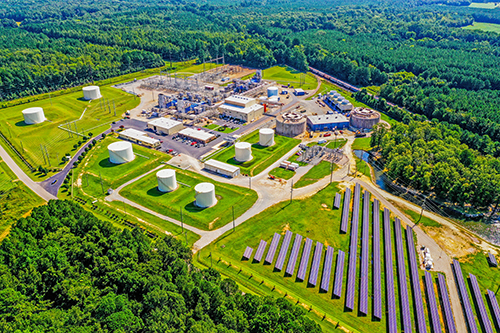
PWC has the distinction of being the only municipal utility company in North Carolina to own and operate a power plant. The Butler-Warner Generation Plant (BWGP), named in honor of Robert H. Butler and James R. Warner, former chairmen of the Commission, was originally built to protect PWC customers from incurring high peaking power costs.
PWC negotiated a long-term full-requirements power supply contract with Progress Energy Corporation (now Duke Energy Progress) which began in 2012, and a companion lease agreement for BWGP was also negotiated. Under the terms of this lease agreement, DEP was given the right to dispatch BWGP to meet the needs of the DEP system in exchange for a capacity payment based on how well BWGP performs. The revenue from the lease agreement is used to reduce the rates charged to PWC customers. The current lease term was scheduled to expire in 2023 and was extended until 2024. A new agreement has been established that took effect in 2024 and will expire in 2032.
The current BWGP equipment is a result of consistent forward-thinking and planning by PWC Commissioners and staff in the face of an evolving electric industry. In 1975, PWC began studying plans to generate our own power. Recommendations were made to install 25 MW gas turbine-powered generating units. By the summer of 1976, the first two generating units were in operation. Between 1976 and 1980, six additional gas turbine generators were installed, bringing the plant’s total generating capacity to a maximum of 200 MW, using either natural gas or fuel oil. In 1988, six of these units were converted to a combined-cycle steam mode, which increased generating capacity of the plant by approximately 65 MW, to a total maximum of 265 MW of generating capacity.
On April 28, 1989, the plant was officially dedicated and named the Butler-Warner Generation Plant in honor of Robert H. Butler and James R. Warner. Mr. Butler served as PWC Commission Chair from 1974-1981, while Mr. Warner served as Chair from 1981-1988.
Community Solar/Battery Storage
In 2019, PWC built North Carolina’s first municipal Community Solar/Battery Storage Project, which is located adjacent to the plant. The solar project can generate up to 1 MW of energy, and BWGP controls the charging and discharging of the stored energy/battery based on likelihood of DEP system peak. While the battery can be charged from the solar array, it’s typically charged from the grid at night, when there is no possibility of the peak hour occurring. In 2021, PWC installed additional battery storage capacity and can now generate 2 MW per hour over the four-hour peak demand period to offset the peak demand. This capability can lead to savings of approximately $480,000 annually. A 4 MW expansion of the solar generation capacity at BWGP is scheduled for completion in 2026.
Butler-Warner Generation Plant Facts
- Initial Installation: 1976
- Major Upgrade: 1988, 1992
- Generation Capacity: 265,000 kW
- Features: 8 GE Turbines (25,000 kW) each; 65,000 kW Steam Turbine; 1 MW Community Solar Farm, 2 MW Battery Storage
- Summer System Peak Demand: 476.6 MW (August 9, 2007)
- Winter System Peak Demand: 492.6 MW (February 20, 2015)
- Distinctions: Included on list of “Plants to See” by the World Energy Conference & APPA