
Electric Service
PWC’s electric system ensures that electric energy purchased from energy suppliers and generated at PWC’s own generation plant is safely and efficiently delivered to its customers at competitive rates. PWC currently purchases electricity from Duke Energy Progress (DEP) and from the Southeastern Power Administration (SEPA). PWC has the distinction of being the only municipal utility in North Carolina to own and operate an electric generation plant. The Butler-Warner Generation Plant (BWGP) is named in honor of Robert H. Butler and James R. Warner, former chairmen of the Commission.
In July 2012, PWC became a full-requirements customer of DEP as part of a new 20-year power supply agreement signed in June 2009. PWC pays a fixed annual capacity and energy charge with a formula-based annual true-up based on DEP’s system average costs. In a separate agreement, BWGP is dispatched by DEP to meet the combined needs of PWC and DEP customers. PWC will continue to operate and maintain the plant, while DEP will reimburse PWC for certain operating costs and pay a fee based on plant performance. This provides PWC an additional source of revenue to offset the effect of power cost increases.
In November 2019, PWC and DEP amended the contract, with the modifications expected to save PWC approximately $313 million (net present value savings) compared to the prior agreement, including $33 million in savings before 2024 when the terms of the current agreement ended. The terms of the amended agreement run through 2042, and PWC has the option to end the contract in 2032 with a three-year notice. In a separate agreement, DEP agreed to extend its contract to lease BWGP. The new terms extended the contract through June 2024 for an additional $5 million in PWC revenue. PWC may be able to achieve additional savings beyond 2024 as long as operational requirements are met.
PWC provides electric service to approximately 60% of the Fayetteville/Cumberland County area. During FY2025, electric service was provided to 86,466 customers. PWC purchased over 2 million MWH of electricity to meet the ever-increasing demand for service. The energy generated by PWC’s Community Solar Array was 1,454,371 kWh. The highest hourly peak demand ever recorded on the PWC system was 499 MW, which occurred on February 20, 2015. The highest hourly peak demand ever recorded during the summer season on the PWC system was 480 MW, which occurred on August 9, 2007. For comparison, the hourly peak demand recorded during FY2025 was 421 MW, which occurred on January 16, 2025.
Fayetteville Electric Service History
The City of Fayetteville has furnished electricity to its citizens since 1900. Fayetteville, like many other North Carolina cities and others across the nation, did not organize an electric utility as a profit-making public enterprise; it did so because that was the only way the citizens could enjoy the benefits of electricity.
The first electric plant of any kind in Fayetteville was installed by the Phoenix Cotton Mill on Ann Street. This plant was driven by water power from Cross Creek, and its output operated the mill and some
commercial lighting. In 1900, the city constructed a steam-driven plant on a site in the 500 block of Russell Street, and immediately began to enlarge the electric distribution system. At that time, the city had a population of less than 5,000 people. The City operated this electric plant for about five years.
Just prior to 1905, the plant became inadequate to supply the city’s total electric needs, and was leased to Fayetteville Traction and Power Company. This company constructed a transmission line into Fayetteville from its hydroelectric plant in Manchester, N.C. Fayetteville then purchased its electric power from the company and continued to operate its electric distribution system. This arrangement continued until 1914, when Fayetteville Traction and Power Company failed.
At this time, all the generating equipment was overloaded. The Commission signed a contract with Henry T. Dechert of Philadelphia, Trustee for the Fayetteville Traction and Power Company, for the purchase of power. Mr. Dechert agreed to increase the generation capacity at Manchester and at Fayetteville.
Before this was accomplished, the Commission canceled the contract with Mr. Dechert and contracted with Carolina Power & Light Company (now DEP) for the purchase of electric power. Since that time, DEP has remained the principal source of power for Fayetteville, although the City has continued to own and operate its own distribution system through the years.
Construction of the BWGP began in the early 1970s and has continued to evolve in response to increasing customer needs. Between 1976 and 1980, PWC installed eight peak-shaving gas turbine generators capable of producing 200 megawatts (MW) of electricity. In 1988, six of these units were converted to a combined-cycle steam mode which increased generating capacity by approximately 65 MW, for a total of 265 MW.
PWC has constantly expanded facilities to keep pace with the accelerated growth of its service area, which includes Fayetteville and a sizable area of Cumberland County. Expansion of the electrical system has been significant – from a 20,000 kW system (two substations) in 1960, to a 410,000 kW load (27 substations) in 1995. Currently, PWC has 32 substations that are designed to handle a system load of more than 600,000 kW. PWC also has one deactivated substation that is used for training purposes. PWC has three points-of-delivery (POD) of bulk electric power from DEP: POD #1 (Owen Drive)–began operation in 1969; POD #2 (the rural area east of the Cape Fear River)–began operation in 1973; and POD #3 (Cliffdale Road)–began operation in 1994.
PWC has a 1 MW community solar farm that has provided renewable energy since 2019. In 2025, PWC began expanding solar generating capacity. The Gillespie Street Solar Farm, capable of producing 1.9 MW, became fully operational in 2025. Rockfish Solar Farm, with 4.8 MW generation capacity, will be completed in the fall of 2025. Construction of the Carvers Falls Solar Farm (4.8 MW) and the expansion of solar panels at BWGP (4 MW) are planned for completion in 2026. PWC also has 2 MW of battery storage at BWGP. Batteries are deployed during peak usage to reduce demand on the electrical system and ultimately lower PWC power supply costs.
Beginning in 2009, PWC launched a program to rebuild or upgrade all of its existing substations, targeting completion of one or two substations per year. These substations are designed as Smart Substations, equipped with state-of-the-art microprocessor-based protective relays, automation, and controls.
By the end of 2020, all three points-of-delivery were upgraded with the replacement of the 230,000-volt power circuit breakers and the upgrading of all the protective relays, automation, batteries, and control systems. By the end of FY2025, 18 substations under this program have been completed with another two slated for completion in FY2026. Over the last 16 years, 18 substations have had new state-of-the art main power transformers installed. Design work on additional upgrades, rebuilds, and new facilities is underway and consistent with PWC’s five-year budget plan.
In 2014, PWC began replacing conventional street lighting with light emitting diode (LED) street lighting. We currently have 25,078 street lights and have replaced 100% of them. In 2018, PWC began its area light replacement program. We currently have 12,945 area lights. To date, we have replaced 100% of them. Thoroughfare lighting is also being changed to LED and brought up to the national IES lighting standards. To date, this project is 98% complete, with minor additions continuing.
Power is received from DEP at 230,000 volts and transformed to 66,000 volts. Transmission of electric power to substations is accomplished by more than 120 circuit miles of 69-kV lines, serving over 86,000 electric customers, including 22 industrial customers, among which is the state’s largest manufacturing plant, Goodyear Tire & Rubber.
Electric System Facts
- Summer Peak Load: 480 MW (Aug. 9, 2007)
- Winter Peak Load: 499 MW (Feb. 20, 2015)
- Average Load: 228 MW
- Average Monthly Peak: 352 MW (CY2024)
Three Main Components:
- Services & Lighting
- Generation & Power Supply
- Transmission & Distribution
Services & Lighting Customers (as of June 30, 2025):
- Total: 86,466
- Residential: 76,296
- Non-Residential: 10,148
- Industrial: 22
Street Lights
- Inside City: 20,205 (Includes 254 Inside City – Pedestrian Light Fixtures)
- Outside City: 1,777 (Includes 411 Private Outside City Street Lights)
- Private Lighting Inside City: 3,096
- Rented Area Lights: 12,945 (Includes 84 Hope Mills City Street Lights – billed to Hope Mills)
Generation & Power Supply
- 200,000 kW of Combustion Turbines
- 65,000 kW Steam Turbine
- 3 230kV Delivery Points from Duke Energy Progress (DEP): Owen Dr., Butler-Warner Generation Plant, Reilly Rd.
- Connected to Regional Transmission Grid
- Current Long-Term Power Supply Agreement: DEP – new full-requirements Power Supply Agreement began July 2012 (2019 modification), expires June 2042; all capacity and energy needs of PWC provided by DEP. Power Sales Agreement with DEP provides additional revenue stream through the sale of capacity and energy from that facility, which is used to offset increased power costs.
- Built NC’s first municipal Community Solar farm (1MW) that helps meet state regulations for providing electricity from renewable resources; includes a 2MW battery storage unit used to reduce the amount of energy purchased during peak times.
- Gilespie St. Solar Farm in service 2 MW came on line April 2025
- On July 31, 2025, BWGP ran for 324 consecutive hours generating electricity, shattering the previous record of 164 hours on January 18, 2018
Solar Farms
- Butler-Warner Generation Plant: Community Solar, Completed 2019, 1 MW
- Gillespie Street Solar Farm: Completed 2025, 1.8 MW
- Rockfish Creek Water Reclamation Facility Solar Farm: Expected Construction Complete Late 2025, 4.87 MW
- Carvers Falls Road Solar Farm: Expected Construction Complete in 2026, 4.87 MW
- Butler-Warner Generation Plant Solar Farm Expansion: Expected Construction Complete in 2026, 4 MW
Distribution System
- Supervisory Control System Monitors & Controls 32 Distribution Substations; 3 Points of Delivery (POD)
- 2.34 Miles of 230 kV Transmission Lines
- 119.81 Circuit Miles of 69 kV Sub-Transmission Lines
- 114.36 Pole Miles of 69 kV Sub-Transmission lines
- 690.17 Circuit Miles of Overhead Distribution (2247.06 Conductor Miles)
- 49,588 Distribution Line Poles (PWC Owned)
- 25,156 Distribution Line Transformers
- 673.90 Circuit Miles of Underground Primary Distribution Conductor (1207.46 Cable/Conductor Miles)
Butler-Warner Generation Plant
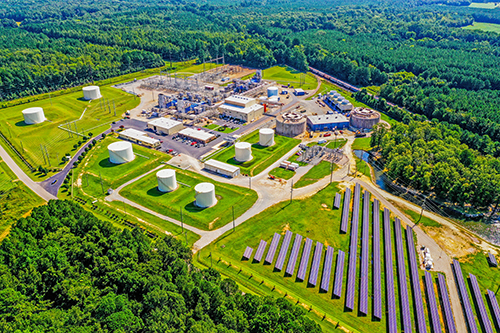
PWC has the distinction of being the only municipal utility company in North Carolina to own and operate a power plant. The Butler-Warner Generation Plant (BWGP), named in honor of Robert H. Butler and James R. Warner, former chairmen of the Commission, was originally built to protect PWC customers from incurring high peaking power costs.
PWC negotiated a long-term full-requirements power supply contract with Progress Energy Corporation (now Duke Energy Progress) which began in 2012, and a companion lease agreement for BWGP was also negotiated. Under the terms of this lease agreement, DEP was given the right to dispatch BWGP to meet the needs of the DEP system in exchange for a capacity payment based on how well BWGP performs. The revenue from the lease agreement is used to reduce the rates charged to PWC customers. The current lease term was scheduled to expire in 2023 and was extended until 2024. A new agreement has been established that took effect in 2024 and will expire in 2032.
The current BWGP equipment is a result of consistent forward-thinking and planning by PWC Commissioners and staff in the face of an evolving electric industry. In 1975, PWC began studying plans to generate our own power. Recommendations were made to install 25 MW gas turbine-powered generating units. By the summer of 1976, the first two generating units were in operation. Between 1976 and 1980, six additional gas turbine generators were installed, bringing the plant’s total generating capacity to a maximum of 200 MW, using either natural gas or fuel oil. In 1988, six of these units were converted to a combined-cycle steam mode, which increased generating capacity of the plant by approximately 65 MW, to a total maximum of 265 MW of generating capacity.
On April 28, 1989, the plant was officially dedicated and named the Butler-Warner Generation Plant in honor of Robert H. Butler and James R. Warner. Mr. Butler served as PWC Commission Chair from 1974-1981, while Mr. Warner served as Chair from 1981-1988.
Community Solar/Battery Storage
In 2019, PWC built North Carolina’s first municipal Community Solar/Battery Storage Project, which is located adjacent to the plant. The solar project can generate up to 1 MW of energy, and BWGP controls the charging and discharging of the stored energy/battery based on likelihood of DEP system peak. While the battery can be charged from the solar array, it’s typically charged from the grid at night, when there is no possibility of the peak hour occurring. In 2021, PWC installed additional battery storage capacity and can now generate 2 MW per hour over the four-hour peak demand period to offset the peak demand. This capability can lead to savings of approximately $480,000 annually. A 4 MW expansion of the solar generation capacity at BWGP is scheduled for completion in 2026.
Butler-Warner Generation Plant Facts
- Initial Installation: 1976
- Major Upgrade: 1988, 1992
- Generation Capacity: 265,000 kW
- Features: 8 GE Turbines (25,000 kW) each; 65,000 kW Steam Turbine; 1 MW Community Solar Farm, 2 MW Battery Storage
- Summer System Peak Demand: 476.6 MW (August 9, 2007)
- Winter System Peak Demand: 492.6 MW (February 20, 2015)
- Distinctions: Included on list of “Plants to See” by the World Energy Conference & APPA